Audio
Audio Shorts
 Movies & Games
 Blog & Stories
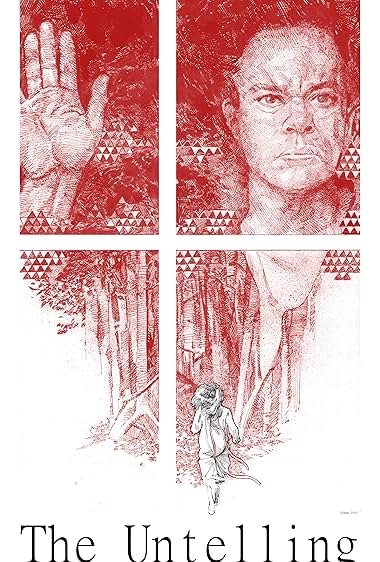
The house I grew up in has always had a smell of damp earth and old wood, even on the sunniest days. When I moved back with my two children after my husband walked out, I thought the familiarity would be a comfort. It wasn’t. Within a week, I noticed the salt. Thin, white lines like crystallized tears creeping up the baseboards in the hallway. My mother blamed the old pipes, but I knew better. The salt was a warning, or perhaps a seal.
At first, I dismissed the cold spots in the children’s room, the way the air would turn heavy and still at 3:17 AM each night. My daughter, Alice, started sleepwalking, always ending up in the kitchen, her small fingers tracing patterns on the floor. My son, Bram, complained of a ‘wet dog’ smell following him. I told myself it was stress, the disruption of our lives. But then I began to see him—a vague, dark shape at the edge of my vision, a silhouette with too-long limbs that never quite looked human.
One evening, I found Alice drawing in her notebook. She had sketched a figure with charcoal black eyes, its mouth stretched impossibly wide. ‘He says he’s lonely,’ she said without looking up. ‘He wants us to be his family now.’ I forced a smile and took the notebook, but I couldn’t shake the feeling that we were being watched. That night, I heard a thumping from the attic, rhythmic and deliberate, like a heartbeat.
Desperate, I consulted an old book from my grandmother’s shelf, filled with folk remedies and superstitions. I found a passage about ‘The Weeping Man,’ a spirit that attaches to women who are vulnerable, feeding on their sorrow and slowly replacing their loved ones. It said the only way to banish him was to find his true name, which he would never reveal, and to inscribe it in salt around the house. I had been sealing the salt lines, but I hadn’t used his name because I didn’t know it.
Determined to end this, I began to research my family’s history, hoping to find a connection. I unearthed an old diary belonging to my great-grandmother. She wrote of a man who courted her, a man who smelled of rain and soil, who could make the candle flames dance with a whisper. She called him ‘Ember’ because his eyes seemed to glow like dying coals. She escaped him by moving across the country and never speaking his name again. I felt a chill—was this the same entity, biding its time for generations?
I decided to perform a ritual to draw him out and force his true name. In the dead of night, I lit black candles and stood in a circle of salt in the attic, where the presence was strongest. I called out, ‘I know you are here. Show yourself!’ The shadows pooled in the corner, and he stepped out—tall, gaunt, his skin the color of bleached bone. His eyes were indeed like embers, but there was no warmth in them. ‘You have my attention,’ he said, his voice like gravel. ‘But you have not my name.’
In that moment, I realized with horror that my grandmother had kept a second diary, hidden in the back of the closet. I had found it earlier but hadn’t opened it. I remembered a single line she had written in a trembling script: ‘His name is not Ember; it is the sound of water dripping on stone, the echo of a forgotten lullaby.’ I shuddered. How could I inscribe a feeling?
As he began to advance, the salt lines around me flickered with a sickly green light. I knew I had to act. I grabbed the salt and wrote in the air the words from the diary, over and over: ‘Drip, drip, lullaby.’ Nothing happened. I was scrambling, casting about for anything. The children were asleep downstairs, unaware. I remembered Alice’s drawing of the smiling mouth, and I screamed, ‘Your name is Hunger! You feed on our pain!
Something shifted. The creature let out a scream that was not human—a high-pitched wail that shattered the attic windows. The candles died, and the cold engulfed me. But when I gasped for breath, I was alone. The salt lines had burned into the floor, forming a single word: ‘Bound.’ I did not sleep that night, and I never heard the name again.
Now, months later, the house is quiet, but I can still taste salt in the air. The children no longer dream of him, but I sometimes catch Alice staring at the attic door with a strange smile. My mother says I’m paranoid. But every time I find a new salt line forming, crawling higher up the wall, I know it’s not for protection—it’s his way of saying he is still here, patiently waiting for the moment I slip and speak his true name, the one I still don’t know.