Audio
Audio Shorts
 Movies & Games
 Blog & Stories
I’ve always prided myself on being a rational man. Ghosts, demons, cryptids—all of it was fodder for campfire tales and late-night talk radio. But life has a way of sewing doubt into the sturdiest of skeptic’s garments. My skepticism began to fray the year I moved into the old Weatherby House, a sprawling Victorian that had been converted into four apartments. My roommates were a mixed lot: there was Clara, a painter with a penchant for midnight walks, and Marta, a pragmatic nurse who believed in little beyond the visible. I was the third, a taxidermist’s assistant, oddly comfortable with the dead.
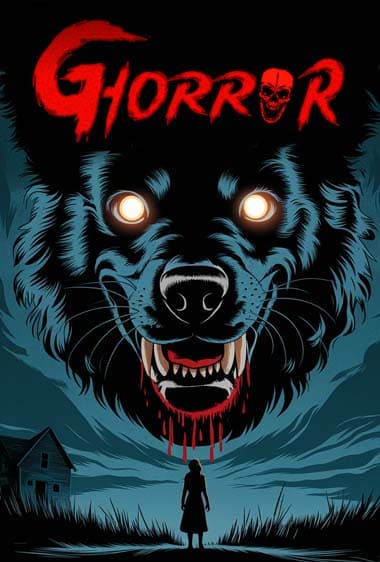
Our apartment was on the top floor, and to reach it, we had to climb a narrow, twisting staircase that creaked like a ship in a storm. It was on one of those climbs, laden with groceries, that Clara stopped dead. ‘There’s a dog,’ she said, pointing at the landing above. ‘A big one, black and white, with fur that looks like it’s been through a hedge backwards.’ Marta and I squinted, seeing nothing. ‘It’s following us,’ Clara added, her voice oddly calm, as if she were narrating a nature documentary. I felt a chill that had nothing to do with the draft, and I whispered to the dog, a stupid thing I do around animals, ‘Here, boy.’ Clara’s eyes went wide as she watched something approach me. ‘He’s sniffing your hand,’ she said. I felt a sensation, like a warm, wet press against my palm, and then a phantom lick. I yanked my hand back, my heart hammering. Marta rolled her eyes. ‘You two are worse than children.’ But I knew what I had felt.
Over the following weeks, the dog became a constant companion to Clara. She would describe its antics—circling her easel, sleeping at the foot of her bed—while Marta and I saw nothing. It unnerved me, but also, shamefully, comforted me. I missed my own dogs back home, and the idea of a spectral canine guardian was strangely heartening. Then things began to change. Clara started to fade. Not literally, but her energy drained. She’d stare out the window for hours, muttering about a ‘tailor’ who was ‘measuring’ her. Marta dismissed it as exhaustion, but I noticed the seamstress’s tape measure that had appeared on Clara’s dresser, coiled like a snake, its yellowed numbers barely legible. I tried to rationalize it as a thrift store find, but Clara claimed she’d never bought it.
One night, I woke to the sound of scissors snip-snipping in the hallway. I crept out, my heart in my throat. The hallway was empty, but from Clara’s room came a low, guttural humming. I pushed the door open. Clara was standing in the middle of the room, naked to the waist, her skin crisscrossed with red, angry lines—like the markings on a dressmaker’s pattern. She was staring at her reflection, which was not her reflection. In the mirror, a tall, thin figure with elongated limbs and a featureless face, except for a mouth that was a lipless slit, was draping a shimmering, translucent fabric over Clara’s form. The figure’s hands were long, with too many joints, and they moved with the precision of a master tailor. I must have gasped, because the figure’s head snapped toward me. Its mouth stretched into a grin that was all teeth, and it whispered, ‘I must take her measure… for the great moth.’ Then it vanished, leaving Clara crumpled on the floor.
Clara was never the same. She became catatonic, muttering about the ‘fabric of her soul’ being ‘never enough’. The dog, which she’d seen faithfully for weeks, was gone. I was consumed by terror, but also a morbid curiosity. I began to research the history of the Weatherby House. It had been built by a tailor named Elias Grimshaw, who was rumored to have made a pact with something unnatural to become the finest clothier of his age. He was found dead in his workshop, his mouth sewn shut with silver thread, and a moth’s wings pinned to his breast. The house had a reputation for ‘ghosts,’ but I now knew it was something more insidious—a hungry presence that fed on the essence of its victims, using them as material for its infernal garments.
I was determined to stop it, but I was also afraid. I set out to find the source of its power. In the basement, behind a false wall, I discovered old mannequins, each dressed in a garment that seemed to shimmer with a trapped human essence. Among them was a coat that I recognized—it was made of the same translucent fabric I’d seen in Clara’s room. As I reached for it, a cold hand seized my wrist. I turned to see the tailor, its face now a collage of every victim’s visage, shifting like a kaleidoscope. ‘You have a good frame,’ it said, its voice like the rustle of dead leaves. ‘I could use you for my next masterpiece.’ I felt a sickening pull, as if it was drawing out a thread from my very soul. I screamed and grabbed the coat, pulling it off the mannequin. The garment tore, and with a shriek, the tailor disintegrated into a cloud of dust and moth wings.
The next day, Clara was back to normal, though she had no memory of the past month. She left the apartment, and I did too soon after, my skepticism shattered. I now know that there are forces that defy explanation, and some are not merely otherworldly—they are tailored, fitted to each of us, waiting to measure us for the final garment we shall wear. I may have destroyed that tailor, but its pattern remains, and I can’t help but feel its scissors snipping at the edges of my own life, preparing to take my measure. I hope I am wrong, but I no longer trust the whisper of cold threads.