Audio
Audio Shorts
 Movies & Games
 Blog & Stories
I never questioned the old lighthouse keeper’s routine. Every evening, at the stroke of nine, the beam would sweep across the salt-crusted rocks, a mechanical heartbeat that had pulsed for as long as anyone could remember. I was sixteen when I came to live with my grandfather, Elias, after my parents’ accident. He was a man of few words, his face weathered like the cliffs he tended. He kept the lighthouse, and I kept him company, fetching his tools, listening to his gruff instructions. But there was a rule I learned early: never, ever approach the lighthouse after sunset.
One night, a summer storm rolled in from the sea, and the power flickered. I was in the kitchen, reading by oil lamp, when I noticed the clock read 9:15. The beam from the lighthouse had stopped. A chill ran through me. Grandfather would never let the light go out. I pulled on my oilskin and struggled against the wind toward the lighthouse, my lantern throwing wild shadows.
Inside, the spiral stairs were slick with dampness. The lamps were cold, and a strange smell hung in the air—like copper and burnt salt. And there, at the top, I saw him. Grandfather stood with his back to me, silhouetted against the dark window. ‘Grandfather?’ I called. ‘Why is the light out?’ He didn’t turn. He just spoke, his voice hollow, as if echoing from a deep cave: ‘Nothing to guide them tonight.’ I felt a knot in my stomach. I reached out to tap his shoulder, but before I could, he turned.
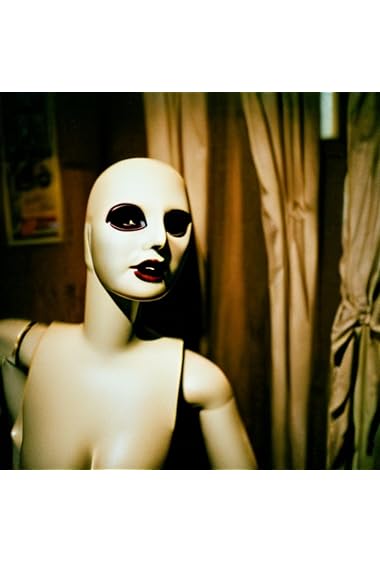
His face was smooth, featureless. No eyes, no nose, no mouth—just a blank, pale oval. Yet it was him. The same broad shoulders, the same worn jacket. I staggered back, my heart hammering. ‘You must leave,’ the thing that wore my grandfather’s body said, its voice now a buzz of static. ‘The bargain holds until the tide turns.’ I ran, stumbling down the stairs, out into the storm, and didn’t stop until I reached the village.
The next morning, Grandfather was sitting at the kitchen table as if nothing had happened. The lighthouse beam swept reliably. I tried to ask him about the night, but he just looked at me with his old, tired eyes and said, ‘Everyone has their chores, boy. Mine is to keep the light. Some nights, the light keeps itself.’ He never explained. But I noticed he started going to bed earlier and earlier, and sometimes, when he thought I wasn’t looking, he’d touch his face as if checking something was still there.
I told no one, but I began to watch. I noticed that on nights when the sea was calm, the figure in the lighthouse would stand at the window, staring out, and sometimes I’d see the silhouette of my grandfather and another, taller form beside it. I took to leaving food for him at the base of the tower, and one night, I found a note in his handwriting: ‘The light must be fed. Not with oil, but with memory. When I forget, you must remember.’ I didn’t understand then.
Two weeks later, I found Grandfather’s body in his bed, his face peaceful, but his eyes were gone—just empty sockets. The coroner said it was a heart attack. But at the funeral, I saw the lighthouse beam flicker, and from the tower, I could have sworn I saw a tall, featureless form watching. I’ve inherited the lighthouse now. I light the lamp every night, and I keep my grandfather’s journals. In the last one, he wrote: ‘They come from the deep, and they need a keeper to light the way. The keeper’s soul is the lantern. When the light goes out, they come ashore.’ I haven’t missed a sunset since. But last night, as I was trimming the wick, I saw my reflection in the glass—and for a moment, it had no face.